Csaba Palotai, the professor, explains the inexplicable:
On Thursday (Feb. 22), a phone booth-sized spacecraft named Odysseus made history. But this successful landing was far from flawless. Several days after touchdown, it became clear that Odysseus broke one of its six legs upon landing, and had ended up toppled on its side. With limited power reaching the lander’s solar cells, engineers powered it down, potentially for good, on Feb. 29.
Odysseus’ challenges add to a trend of troubled lunar landings, with five of the previous nine attempted moon landings ending poorly for various nations and private companies.
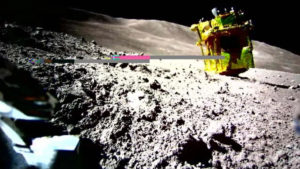
Weeks earlier, on Jan. 19, Japan’s Smart Lander for Investigating the Moon (SLIM) spacecraft successfully completed the country’s first moon landing — albeit ending up upside down on the lunar surface due to an engine malfunction during descent. The lopsided lander’s solar cells faced the wrong direction and failed to power its instruments and communications, forcing engineers to shut it down in fear of battery discharge. Just 10 days prior to SLIM’s landing, a private U.S. moon lander named Peregrine encountered many anomalies after launch, including a propellant leak that prevented the spacecraft from landing on the moon. It was ultimately rerouted to crash into Earth’s atmosphere. Other lunar landing attempts made by Japan and Russia in 2023 similarly ended in catastrophic crashes, this time on the moon itself.
„We did not get ‘dumber’ since the Apollo landings,” Csaba Palotai, a professor of physics and space sciences at the Florida Institute of Technology in Melbourne, told Live Science. Technology is significantly better today; your cellphone has more computational power than computers had in the 1970s. „But since the ’70s there have been no astronauts and pilots on the landers to correct what the computers can’t or won’t,” Palotai added.
Landing on the moon is hard, with or without human pilots.
A major hurdle is the moon’s virtual lack of atmosphere. The lunar atmosphere is very thin and varies with time, preventing engineers from including parachutes to slow down spacecraft, Palotai said. Instead, missions use fuel-powered propulsion systems to descend onto the moon’s surface, making it challenging to slow the spacecraft from a few kilometers per second to a perfect halt.
Yet this and other lunar exploration challenges are not new…
Here is the usual explanation: