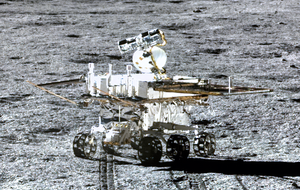
By observing how lunar regolith stuck to the Yutu-2 rover’s wire mesh wheels and measuring how the wheels occasionally slipped in the regolith, the researchers were able to calculate its consistency and load-bearing properties.
While missions like NASA’s Lunar Reconnaissance Orbiter have provided detailed maps of the entire lunar surface, Yutu-2 has yielded information about the subsurface structure of the Moon’s far side and details about the lunar regolith that you can only learn by physically stirring up the dirt. The results could help guide further lunar exploration by both China and the US.
Yutu-2 made three critical discoveries by playing in the lunar dirt, all of which could have implications for future robotic and human exploration of the far side of the Moon and our satellite’s southern polar region.
https://www.inverse.com/science/three-take-aways-from-chinas-lunar-rover