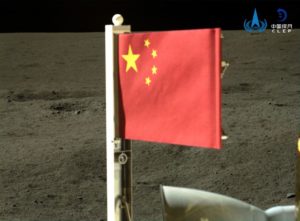
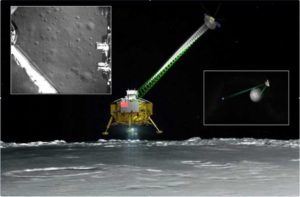
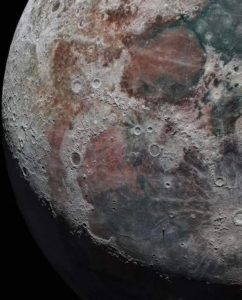
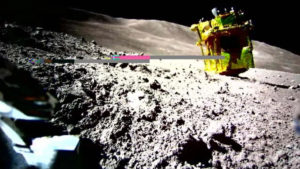
The competition during the Cold War began again with the participation of Japan, China, Russia, the USA, South Korea and India. The goal is not to prove which nation is different, but to exploit the Moon’s resources as soon as possible.
But still, what is there on the moon that we need so much? Lots of minerals and water. We take soil samples to find out how much water (frozen aquifers can be used not only for drinking, we could also break down H2O into hydrogen that can be used as fuel or oxygen needed for breathing), helium, rare earth metals used in smartphones, which – given that the Earth we are beginning to deplete the resources of the planet called – it serves as a new mine to cover our growing hunger.
Billions on the moon
The sudden start of rocket construction clearly shows how big a deal this is. NASA has proposed a series of landing sites on the celestial body for its new Artemis program, with India recently landing its Chandrayaan-3 spacecraft near Manzinus Crater near the South Pole, while Russia hopes to discover a similar site near Boguslavsky Crater before its Luna-25 probe lands on the crashed at the beginning of the month. Meanwhile, China plans to send astronauts to the lunar surface by 2030 and has earmarked a number of similar landing sites to the US space agency. How can this be very easy? Of course, it is an international conflict, at least between the USA and China. But the chance of obtaining the raw material and securing the location is much more important… This was also the case during previous attempts to regulate the Moon: neither the United States of America, nor Russia, nor China signed the 1979 Moon Agreement.
What do you need from there at all costs?
Which in practice probably means that as soon as they are able to send robots, astronauts, and researchers to the celestial body, the mining of raw materials will begin. But why is it worth undertaking this? Mainly for water. From the analyzes carried out by NASA’s Lunar Reconnaissance Orbiter, we know that the lunar poles – especially the craters in the southern part, it is no coincidence that so many countries target that area – contain more than 600 billion kilograms of water ice, which would be enough to fill at least 240,000 Olympic-sized swimming pools sufficient. Considering that there is more than one billion cubic kilometers of water on Earth, it may seem strange that the moon is so sought after, and even one of the most valuable resources. One of its main values is that it is there, and it does not have to be transported from here to there at an immeasurably expensive and difficult price. On the other hand, one of the conditions of life, i.e. if we want to use the moon as a base for further space research or even military purposes, then we need to extract water from it in order to stay there for a long time and through hydrogen we have enough rocket fuel.
Rare metals
Another great value of the Moon is that it contains rare metals that are essential for our modern world. Scientists believe that many rare metals may be hidden in the cold, dark craters of the Moon’s south pole. They are vital in smartphones, computers, hybrid car batteries and medical equipment. Scandium and yttrium are used in vehicle engines, in the production of glass or ceramics, in electronic devices and radar systems, and appear to be hidden in large quantities in the celestial body. Other resources include basalt, iron, quartz, and silicon, all of which can be used on Earth to make windows, dishes, and solar cells, while precious metals used in electronics include platinum, palladium, and rhodium. Scientists have even discovered titanium ore that is ten times richer than what is found on Earth. And then we didn’t even talk about helium, the „Holy Grail” of energy, which plays an important role in energy production. So many mysterious elements that have attracted the greedy attention of people… for which one innocent „research expedition” will be launched after another…
Who opens the first mine?
More than 400 public and private missions to the moon are estimated to be launched between 2022 and 2032, up from a forecast of 250 a year ago. At least six countries, including Japan and South Korea, as well as a number of private companies funded by who knows exactly, are participating in the competition – as evidenced by the fact that Jeff Bezos-funded Blue Origin recently presented a regolith made of lunar dust made solar panel. Most of them are planning to create permanent bases so that there is time and space to survey and start mining.. We can easily imagine that whoever gets there first will try to reserve as much territory as they can, since the competitors are already chasing after them. The late arrivals will be able to point to the international conventions according to which everything must be divided equally and the moon belongs to everyone, but they would trample on the same if they had managed to be the first to play territory occupier before anyone else.