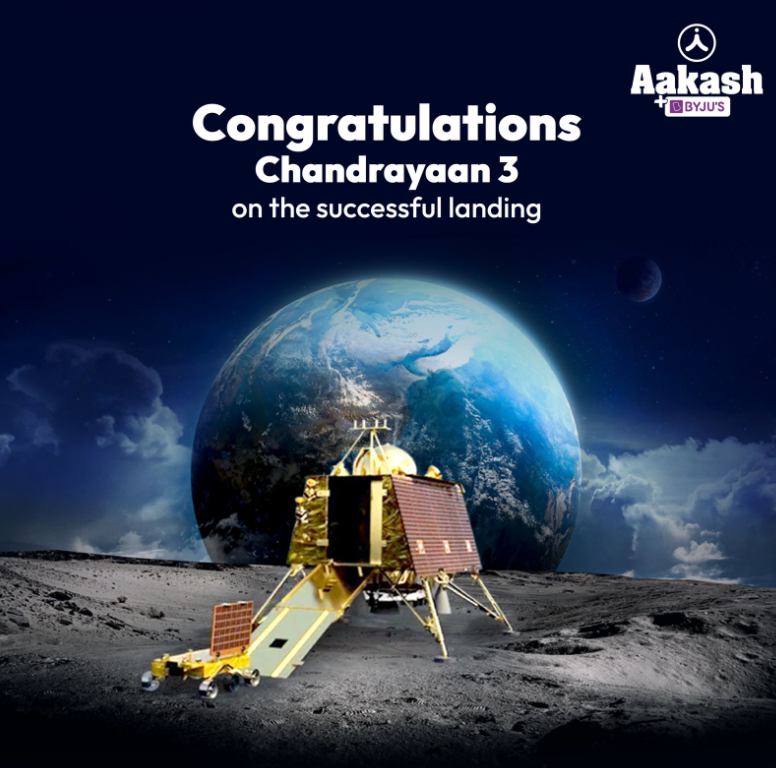
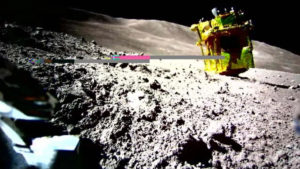
India’s third lunar mission took a new turn when the Vikram lander successfully separated from the Chandrayaan-3 orbiter, beginning final preparations for the landing attempt.
The mission, which ended in mid-July 2023, reached the Moon on August 5th after a series of orbital lifts, and then entered the pre-planned orbit around our celestial companion during a braking maneuver. However, after the successful deceleration, the probe orbited in a rather elongated elliptical orbit, so additional engine maneuvers were necessary to reach a nearly circular orbit at an altitude of about 160 kilometers above the surface of Csándráján-3.
It also marked a new stage in the mission when the Vikram lander safely separated from the orbiter and began independent operation.
However, the real challenge awaits the lander after that – the approximately one and a half ton space vehicle must further reduce its altitude in order to be in the right place at the right time to start the landing procedure. Vikram is not „alone”, because the 26-kilogram Pragyan (Wisdom in Hungarian) automatic rover is on board, which, according to the plans, will roll off the platform after landing and make independent measurements on the surface.
According to the trajectory plans, on the day before the landing, Vikram should approach the surface (periapsis) at about 30 kilometers, because it is from this height that the final descent will begin.
LANDING PROCESS
The first stage of the landing is the so-called rough braking phase, i.e. the „strong braking phase”. This will last approximately 690 seconds, and during this maneuver the probe will mostly try to reduce its horizontal speed. With this operation, Vikram directs itself to a trajectory that crosses the surface of the Moon, so there is no turning back in case of any problems. At the end of the maneuver, the probe will be ~7.4 km above the surface, and approx. It will travel at a speed of 1200 km/h.
This is followed by a short ballistic phase of about 10 seconds. At this point, the probe will rotate from a horizontal orientation to an angle of about 50 degrees so that its engines face the surface, which will be essential for the final landing maneuver.
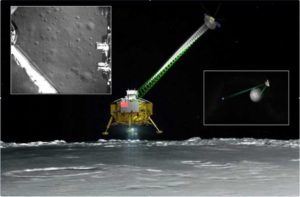
The next step is the fine braking phase. The purpose of this is for the probe to completely reset its horizontal and vertical speed, approx. 800 meters high. Vikram will then remain at this altitude for another 12 seconds with the help of its engines (running them continuously, of course). The reason for this 12-second „stop” is actually very logical: in this time slot, the probe evaluates potentially dangerous areas on the surface, and an AI algorithm selects the most optimal point for landing. Engineers have also equipped the spacecraft with additional laser and radio altimeters so that the on-board computer can track Vikram’s current position relative to the surface as accurately as possible.
The next stage is Terminal Descent Phase 1. Vikram turns off its engines, so the spacecraft begins to descend thanks to the Moon’s gravity. In this case, the probe will turn on the engines again in a lower thrust mode, and it will come down to a height of 150 meters at a constant speed of 18 km/h. Here again, a „floating” phase follows, for 22 seconds, the systems scan the surface again at a height of 150 meters in search of additional sources of danger (walls of craters, slopes, larger rocks). During Terminal Descent Phases 2 and 3, the probe’s altitude is further reduced while optical, laser and radio equipment conduct continuous observations of safe and dangerous areas.
The final landing stage begins at a height of 10 meters: at this point, the spacecraft will shut down all engines and reach the surface of the Moon in free fall. ISRO’s headquarters in Bengaluru will receive the first signal from the surface approximately 1.25 seconds after landing.
After the successful landing, the Vikram undergoes a major inspection, and if the engineers find everything in order, a few hours later the Pragyan will also roll down to the moon, making history in India’s space program. (https://spacejunkie.hu/)
NOTE: COMPLETELY ABSURD, SOME PEOPLE STILL BELIEVE THAT IN 1969, ARMSTRONG AND HIS FRIENDS MADE SUCH A LANDING WITH HAND CONTROL!